Request Free Sample ×

Kindly complete the form below to receive a free sample of this Report

* Please use a valid business email

Leading companies partner with us for data-driven Insights

clients tt-cursor
Hero Background

Multi Camera System Market

ID: MRFR/AT/3914-HCR
111 Pages
Triveni Bhoyar
Last Updated: April 06, 2026

Multi-Camera System Market Research Report By Application (Surveillance, Traffic Monitoring, Smartphones, Sports Broadcasting, Virtual Reality), By Technology (Image Processing, Stereo Vision, 360-degree Cameras, Multi-View Video Coding, Deep Learning), By End Use (Consumer Electronics, Transportation, Security Surveillance, Healthcare, Media Entertainment), By Installation Type (Embedded Systems, Standalone Systems, Integrated Systems) and By Regional (North America, Europe, South America, Asia-Pacific, Middle East and Africa) - Forecast to 2035

Share:
Download PDF ×

We do not share your information with anyone. However, we may send you emails based on your report interest from time to time. You may contact us at any time to opt-out.

Multi Camera System Market Infographic
Purchase Options

Multi Camera System Market Summary

As per Market Research Future analysis, the Multi-Camera System Market was estimated at 2.564 USD Billion in 2024. The Multi-Camera System industry is projected to grow from 2.752 USD Billion in 2025 to 5.567 USD Billion by 2035, exhibiting a compound annual growth rate (CAGR) of 7.3% during the forecast period 2025 - 2035

Key Market Trends & Highlights

The Multi-Camera System Market is poised for substantial growth driven by technological advancements and increasing security demands.

  • North America remains the largest market for multi-camera systems, driven by heightened security concerns and technological innovation.
  • Asia-Pacific is emerging as the fastest-growing region, with rapid adoption of advanced imaging technologies and user-friendly interfaces.
  • The surveillance segment continues to dominate the market, while traffic monitoring is gaining traction as a key growth area.
  • Technological advancements in imaging and the rising demand for security solutions are significant drivers propelling market expansion.

Market Size & Forecast

2024 Market Size 2.564 (USD Billion)
2035 Market Size 5.567 (USD Billion)
CAGR (2025 - 2035) 7.3%

Major Players

Sony (JP), Canon (JP), Panasonic (JP), GoPro (US), Blackmagic Design (AU), DJI (CN), Samsung (KR), Hikvision (CN), Axis Communications (SE)

Our Impact
Enabled $4.3B Revenue Impact for Fortune 500 and Leading Multinationals
Partnering with 2000+ Global Organizations Each Year
30K+ Citations by Top-Tier Firms in the Industry

Multi Camera System Market Trends

The Multi-Camera System Market is currently experiencing a notable evolution, driven by advancements in technology and increasing demand across various sectors. This market encompasses a wide range of applications, including surveillance, broadcasting, and automotive industries. The integration of artificial intelligence and machine learning into multi-camera systems enhances their functionality, allowing for improved image processing and real-time analytics. As organizations seek to optimize operations and enhance security measures, the adoption of these systems appears to be on the rise. Furthermore, the growing trend of smart cities and the need for comprehensive monitoring solutions contribute to the market's expansion. In addition to technological advancements, consumer preferences are shifting towards more sophisticated and user-friendly multi-camera solutions. The emphasis on seamless integration with existing infrastructure and the ability to provide high-quality visuals are becoming increasingly important. As a result, manufacturers are focusing on developing innovative products that cater to these demands. The Multi-Camera System Market seems poised for continued growth, with potential opportunities emerging in various sectors, including retail, healthcare, and transportation. Overall, the landscape of this market is dynamic, reflecting the interplay between technological innovation and evolving consumer needs.

Technological Advancements

The Multi-Camera System Market is witnessing rapid technological advancements, particularly in the areas of image processing and data analytics. Innovations such as artificial intelligence and machine learning are being integrated into these systems, enhancing their capabilities and efficiency. This trend indicates a shift towards more intelligent solutions that can adapt to various environments and requirements.

Increased Demand for Security Solutions

There is a growing demand for multi-camera systems in security applications, driven by heightened concerns over safety and surveillance. Organizations across different sectors are investing in these systems to bolster their security measures. This trend suggests that the Multi-Camera System Market will continue to expand as businesses prioritize safety and risk management.

Shift Towards User-Friendly Interfaces

The Multi-Camera System Market is also experiencing a shift towards more user-friendly interfaces. As consumers seek solutions that are easy to operate and integrate with existing technologies, manufacturers are focusing on developing intuitive systems. This trend highlights the importance of accessibility and usability in driving market growth.

Multi Camera System Market Drivers

Expansion in Consumer Electronics

The consumer electronics sector is contributing to the growth of the Multi-Camera System Market, as manufacturers increasingly incorporate multi-camera setups in smartphones, tablets, and other devices. This trend is driven by consumer demand for enhanced photography and videography capabilities, leading to the development of devices with multiple lenses for varied shooting conditions. The proliferation of social media and content creation platforms has further fueled this demand, as users seek high-quality images and videos. Market analysis indicates that the consumer electronics segment is expected to grow significantly, potentially accounting for over 25% of the multi-camera system market by 2026, reflecting the ongoing evolution of personal technology.

Technological Advancements in Imaging

The Multi-Camera System Market is experiencing a surge in technological advancements, particularly in imaging capabilities. Innovations such as high-definition sensors, enhanced low-light performance, and advanced image processing algorithms are driving the demand for multi-camera systems. These advancements enable superior image quality and versatility, appealing to various sectors including automotive, surveillance, and entertainment. For instance, the integration of artificial intelligence in image analysis is expected to enhance the functionality of multi-camera systems, allowing for real-time data processing and improved decision-making. As a result, the market is projected to grow at a compound annual growth rate of approximately 15% over the next five years, indicating a robust demand for cutting-edge imaging technologies.

Shift Towards User-Friendly Interfaces

The Multi-Camera System Market is witnessing a notable shift towards user-friendly interfaces, which is enhancing the accessibility and usability of these systems. As technology becomes more complex, the demand for intuitive controls and seamless integration with existing systems is increasing. Manufacturers are focusing on developing software that simplifies the operation of multi-camera systems, making them more appealing to a broader audience. This trend is particularly evident in sectors such as retail and hospitality, where ease of use can significantly impact operational efficiency. The market for user-friendly multi-camera systems is projected to grow, as businesses seek solutions that require minimal training and offer straightforward functionality.

Increased Demand for Security Solutions

The rising concerns regarding safety and security are propelling the Multi-Camera System Market forward. With the increasing incidence of crime and the need for surveillance in public spaces, businesses and governments are investing heavily in multi-camera systems. These systems provide comprehensive coverage and real-time monitoring capabilities, which are essential for effective security management. According to recent data, the security segment of the multi-camera system market is expected to account for over 40% of the total market share by 2026. This trend is further supported by the growing adoption of smart city initiatives, where multi-camera systems play a crucial role in enhancing urban safety and operational efficiency.

Growing Adoption in Automotive Applications

The automotive sector is increasingly adopting multi-camera systems, significantly impacting the Multi-Camera System Market. These systems are integral to advanced driver-assistance systems (ADAS), providing critical data for features such as lane departure warnings, parking assistance, and collision avoidance. The demand for enhanced safety features in vehicles is driving manufacturers to integrate multi-camera systems into their designs. Recent estimates suggest that the automotive segment could represent nearly 30% of the overall multi-camera system market by 2027. This trend indicates a shift towards more sophisticated vehicle technologies, where multi-camera systems play a pivotal role in improving road safety and driving experiences.

Market Segment Insights

By Application: Surveillance (Largest) vs. Traffic Monitoring (Fastest-Growing)

In the Multi-Camera System Market, the application segment is primarily composed of Surveillance, Traffic Monitoring, Smartphones, Sports Broadcasting, and Virtual Reality. Among these, Surveillance holds the largest market share due to its extensive deployment in security and monitoring systems across various sectors. Following closely, Traffic Monitoring is rapidly gaining traction and is poised to expand its share significantly as urbanization increases and the need for intelligent transportation systems grows.

Surveillance (Dominant) vs. Traffic Monitoring (Emerging)

Surveillance systems represent the dominant application in the Multi-Camera System Market, primarily driven by heightened security concerns and advances in camera technology that enhance image quality and analytics capabilities. This segment encompasses a broad range of applications, including residential, commercial, and industrial security. On the other hand, Traffic Monitoring is an emerging segment, fueled by the increasing need for smart traffic management solutions and the implementation of smart city initiatives. This segment's growth is characterized by the integration of advanced analytics and real-time data processing, positioning it as a crucial area for innovation and development in the coming years.

By Technology: Image Processing (Largest) vs. Deep Learning (Fastest-Growing)

In the Multi-Camera System Market, Image Processing holds the largest share among the various technologies, playing a pivotal role in enhancing visual data quality and enabling advanced features. Stereo Vision and 360-Degree Cameras follow, each contributing significantly to the innovation landscape. Multi-View Video Coding also has a notable presence, facilitating seamless video streaming, while Deep Learning is rapidly gaining traction as a transformative force in the market, overshadowing traditional methods in some applications.

Technology: Image Processing (Dominant) vs. Deep Learning (Emerging)

Image Processing, being the dominant technology in the Multi-Camera System Market, focuses on enhancing the clarity and accuracy of images captured by multiple cameras. It enables sophisticated functionalities such as real-time video analysis and object detection. In contrast, Deep Learning, categorized as an emerging technology, leverages advanced algorithms to improve image recognition and analytics, thus making systems smarter. The latter is typified by its ability to learn from vast amounts of data, offering capabilities that traditional methods cannot match. As demand for intelligent video solutions surges, the roles of both technologies are expected to evolve, with Image Processing remaining fundamental and Deep Learning paving the way for innovative applications.

By End-Use: Security Surveillance (Largest) vs. Consumer Electronics (Fastest-Growing)

In the Multi-Camera System Market, Security Surveillance holds the largest share, driven by increasing demand for enhanced security measures across residential and commercial sectors. This segment's significance is underscored by rising concerns about safety and theft, leading to the heightened adoption of advanced surveillance systems. On the other hand, Consumer Electronics is rapidly gaining traction as the fastest-growing segment as technological advancements make multi-camera systems more accessible and desirable for home users. Products within this category, such as smart home systems, are increasingly appealing to consumers seeking convenience and safety.

Consumer Electronics (Dominant) vs. Healthcare (Emerging)

The Consumer Electronics segment, encompassing smart cameras and integrated systems, is currently the dominant force in the Multi-Camera System Market. Fueled by innovation in smart technologies and affordability, products in this space are increasingly integrated into everyday life, offering consumer-oriented features such as remote monitoring and seamless connectivity. Meanwhile, the Healthcare segment represents an emerging area for multi-camera systems, driven by increasing demands for telemedicine and patient monitoring solutions. This segment is characterized by the need for enhanced patient safety and the ability to conduct remote diagnostics, making it a vital area of growth as technology integration in healthcare continues to advance.

By Installation Type: Embedded Systems (Largest) vs. Standalone Systems (Fastest-Growing)

In the Multi-Camera System Market, the market share distribution reveals that Embedded Systems hold the largest share, due to their integration into high-end security setups and smart devices. They have become increasingly popular in residential and commercial applications, leading to a robust demand. In contrast, Standalone Systems are rapidly gaining traction, appealing particularly to consumers looking for cost-effective and easy-to-install solutions. Their simplicity makes them attractive, especially in smaller installations where complexity is not required.

Installation Type: Embedded Systems (Dominant) vs. Standalone Systems (Emerging)

Embedded Systems represent the dominant segment within the Multi-Camera System Market, characterized by their sophisticated design and seamless integration capabilities. These systems are often embedded within other devices like security systems, enabling advanced functionalities such as remote monitoring and enhanced analytics. On the other hand, Standalone Systems are an emerging trend, favored for their ease of use and flexibility in deployment. These systems can be set up independently, offering consumers a hassle-free installation experience without the need for extensive technical skills. As demand for simple yet effective surveillance solutions grows, Standalone Systems are poised to capture a larger market share.

Get more detailed insights about Multi Camera System Market

Regional Insights

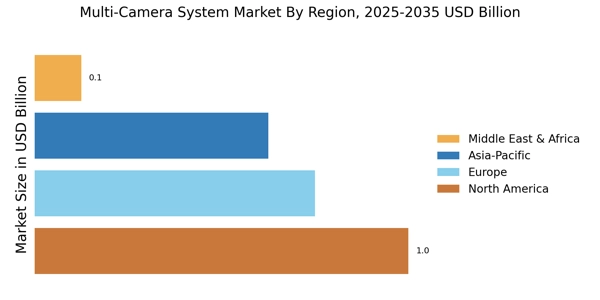
North America : Technology Adoption Leader

North America is the largest market for multi-camera systems, holding approximately 40% of the global share. The region's growth is driven by increasing demand for high-quality video content, advancements in camera technology, and a surge in content creation across various platforms. Regulatory support for digital media and entertainment further catalyzes market expansion, with significant investments in infrastructure and technology. The United States leads the North American market, followed by Canada, with key players like GoPro, Sony, and Canon dominating the landscape. The competitive environment is characterized by rapid innovation and a focus on enhancing user experience. Companies are increasingly investing in R&D to develop advanced multi-camera solutions, catering to both professional and consumer markets.

Europe : Emerging Market Dynamics

Europe is witnessing a robust growth trajectory in the multi-camera system market, accounting for approximately 30% of the global share. The region benefits from strong regulatory frameworks that promote digital innovation and content creation. Countries like Germany and the UK are at the forefront, with increasing investments in media and entertainment driving demand for advanced camera systems. The European market is also influenced by sustainability initiatives, pushing for eco-friendly technology solutions. Leading countries in Europe include Germany, the UK, and France, where major players like Canon and Panasonic are actively expanding their product offerings. The competitive landscape is marked by collaborations and partnerships aimed at enhancing technological capabilities. The presence of established brands and emerging startups fosters a dynamic environment, ensuring continuous innovation in multi-camera systems.

Asia-Pacific : Rapidly Growing Market

Asia-Pacific is rapidly emerging as a significant player in the multi-camera system market, holding around 25% of the global share. The region's growth is fueled by increasing consumer demand for high-definition video content, particularly in countries like China and Japan. The rise of social media and online streaming platforms has further accelerated the adoption of multi-camera systems, supported by favorable government policies promoting digital technology. China is the largest market in the region, followed by Japan and South Korea, with key players like DJI and Samsung leading the charge. The competitive landscape is characterized by aggressive pricing strategies and continuous product innovation. Local manufacturers are increasingly entering the market, enhancing competition and driving technological advancements in multi-camera systems.

Middle East and Africa : Emerging Opportunities Ahead

The Middle East and Africa region is witnessing a gradual increase in the adoption of multi-camera systems, accounting for about 5% of the global market share. The growth is primarily driven by the rising demand for high-quality video content in the entertainment and media sectors. Countries like the UAE and South Africa are leading this trend, supported by government initiatives aimed at boosting the creative economy and digital content production. In the competitive landscape, local players are emerging alongside established brands, creating a diverse market environment. The presence of international companies like Hikvision and Axis Communications enhances competition, while collaborations with local content creators are fostering innovation. As the region continues to develop its digital infrastructure, opportunities for growth in multi-camera systems are expected to expand significantly.

Multi Camera System Market Regional Image

Key Players and Competitive Insights

The Multi-Camera System Market has experienced significant growth and transformation in recent years, driven by advancements in technology and increasing consumer demand for high-quality video production. Companies engaged in this market are continuously evolving their strategies to meet the requirements of diverse sectors, including entertainment, broadcasting, and live events. A variety of players characterizes the competitive landscape, each attempting to carve out their niche through innovative solutions, effective pricing strategies, and enhanced customer service. With the rise of social media and streaming platforms, the need for multi-camera systems equipped with cutting-edge capabilities is more pronounced than ever, leading to ongoing investments in research and development and collaborative endeavors within the industry. Blackmagic Design stands out in the Multi-Camera System Market thanks to its commitment to offering high-quality products at affordable price points, positioning itself effectively against competitors. The company is recognized for its exceptional design and engineering focus, enabling the development of innovative multi-camera solutions that cater to the needs of both professional and amateur users. Blackmagic Design's product range typically includes advanced features such as high frame rates, superior image quality, and seamless integration with various video editing software, further increasing its appeal. Its robust distribution network and prominent presence in trade shows and industry events help raise brand awareness and establish strong relationships with customers, enhancing its market position. Panasonic has significantly impacted the Multi-Camera System Market through its dedication to technological innovation and product diversification. Known for its durable and reliable camera systems, Panasonic's offerings typically include features such as advanced autofocus, high dynamic range, and exceptional low-light performance, which are essential for professional applications in broadcasting and live events. The company's commitment to sustainability, design excellence, and user-friendly interfaces makes its multi-camera systems attractive to a wide range of consumers. Panasonic's extensive distribution framework, along with strategic partnerships and collaborations, strengthens its market presence, enabling it to cater effectively to varying regional demands and maintain a competitive edge in this rapidly evolving marketplace.

Key Companies in the Multi Camera System Market include

Industry Developments

There have been notable developments in the Multi-Camera System Market recently. Companies like Blackmagic Design and Panasonic are enhancing their product offerings with advanced features to capture a larger market share, driven by the increasing demand for high-quality imaging solutions in various sectors, including surveillance, entertainment, and sports. DJI continues to innovate with aerial multi-camera systems for cinematography, while GoPro is extending its reach into adventure sports by integrating multi-camera functionalities into its latest products.

Additionally, Axis Communications and Hikvision are making strides in the security sector through expanded multi-camera capabilities. In terms of mergers and acquisitions, companies like Red Digital Cinema and Canon have been focusing on strategic partnerships to enhance their technological capabilities and service offerings. Moreover, Nikon is investing in RD to boost its market presence, especially in the burgeoning streaming and content creation sectors. Market valuation is on the rise as companies like Sony and Samsung Electronics push the envelope with next-gen technologies, drawing interest from investors and aligning with current market trends aiming for higher quality and enhanced user experience.

This growth trajectory is significantly impacting the landscape of the multi-camera system market, emphasizing a competitive environment.

Future Outlook

Multi Camera System Market Future Outlook

The Multi-Camera System Market is projected to grow at a 7.3% CAGR from 2025 to 2035, driven by advancements in technology, increasing demand for surveillance, and enhanced user experiences.

New opportunities lie in:

  • Integration of AI-driven analytics for real-time monitoring solutions.
  • Development of compact, high-resolution cameras for mobile applications.
  • Expansion into emerging markets with tailored multi-camera solutions.

By 2035, the Multi-Camera System Market is expected to achieve substantial growth and innovation.

Market Segmentation

Multi Camera System Market End-Use Outlook

  • Consumer Electronics
  • Transportation
  • Security Surveillance
  • Healthcare
  • Media Entertainment

Multi Camera System Market Technology Outlook

  • Image Processing
  • Stereo Vision
  • 360-Degree Cameras
  • Multi-View Video Coding
  • Deep Learning

Multi Camera System Market Application Outlook

  • Surveillance
  • Traffic Monitoring
  • Smartphones
  • Sports Broadcasting
  • Virtual Reality

Multi Camera System Market Installation Type Outlook

  • Embedded Systems
  • Standalone Systems
  • Integrated Systems

Report Scope

MARKET SIZE 2024 2.564(USD Billion)
MARKET SIZE 2025 2.752(USD Billion)
MARKET SIZE 2035 5.567(USD Billion)
COMPOUND ANNUAL GROWTH RATE (CAGR) 7.3% (2025 - 2035)
REPORT COVERAGE Revenue Forecast, Competitive Landscape, Growth Factors, and Trends
BASE YEAR 2024
Market Forecast Period 2025 - 2035
Historical Data 2019 - 2024
Market Forecast Units USD Billion
Key Companies Profiled Sony (JP), Canon (JP), Panasonic (JP), GoPro (US), Blackmagic Design (AU), DJI (CN), Samsung (KR), Hikvision (CN), Axis Communications (SE)
Segments Covered Application, Technology, End Use, Installation Type, Regional
Key Market Opportunities Integration of artificial intelligence enhances functionality in the Multi-Camera System Market.
Key Market Dynamics Rising demand for advanced surveillance solutions drives innovation and competition in the Multi-Camera System Market.
Countries Covered North America, Europe, APAC, South America, MEA

Market Highlights

Author
Author
Author Profile
Triveni Bhoyar LinkedIn
Senior Research Analyst
Triveni Bhoyar has over 5 years of experience in the market research industry, specializing in the Automotive and Aerospace & Defense sectors. She has contributed to 200+ reports, including numerous custom projects for leading global companies, delivering solutions to complex business challenges. Renowned for her ability to generate valuable insights, Triveni excels in addressing unique market dynamics with precision and depth. Her expertise spans market sizing, competitive intelligence, and trend analysis, enabling clients to craft data-driven growth strategies. With strong analytical rigor and a client-centric approach, she plays a pivotal role in driving impactful, strategic decision-making.
Co-Author
Co-Author Profile
Swapnil Palwe LinkedIn
Team Lead - Research
With a technical background as Bachelor's in Mechanical Engineering, with MBA in Operations Management , Swapnil has 6+ years of experience in market research, consulting and analytics with the tasks of data mining, analysis, and project execution. He is the POC for our clients, for their consulting projects running under the Automotive/A&D domain. Swapnil has worked on major projects in verticals such as Aerospace & Defense, Automotive and many other domain projects. He has worked on projects for fortune 500 companies' syndicate and consulting projects along with several government projects.
Leave a Comment

FAQs

What is the projected market valuation of the Multi-Camera System Market by 2035?

The Multi-Camera System Market is projected to reach a valuation of 5.567 USD Billion by 2035.

What was the market valuation of the Multi-Camera System Market in 2024?

In 2024, the overall market valuation was 2.564 USD Billion.

What is the expected CAGR for the Multi-Camera System Market during the forecast period 2025 - 2035?

The expected CAGR for the Multi-Camera System Market during the forecast period 2025 - 2035 is 7.3%.

Which application segment is anticipated to experience the highest growth in the Multi-Camera System Market?

The Surveillance application segment is anticipated to grow from 0.8 USD Billion in 2024 to 1.6 USD Billion by 2035.

How does the Traffic Monitoring segment perform in terms of market valuation?

The Traffic Monitoring segment is expected to increase from 0.4 USD Billion in 2024 to 0.9 USD Billion by 2035.

What are the key technologies driving the Multi-Camera System Market?

Key technologies include Image Processing, Stereo Vision, and Deep Learning, with Image Processing projected to grow from 0.8 USD Billion to 1.6 USD Billion by 2035.

Which end-use segment is likely to dominate the Multi-Camera System Market?

The Security Surveillance end-use segment is likely to dominate, growing from 0.9 USD Billion in 2024 to 1.8 USD Billion by 2035.

What installation types are included in the Multi-Camera System Market analysis?

The analysis includes Embedded Systems, Standalone Systems, and Integrated Systems, all projected to grow from 0.769 USD Billion to 1.634 USD Billion by 2035.

Who are the key players in the Multi-Camera System Market?

Key players include Sony, Canon, Panasonic, GoPro, Blackmagic Design, DJI, Samsung, Hikvision, and Axis Communications.

What is the growth outlook for the Sports Broadcasting segment in the Multi-Camera System Market?

The Sports Broadcasting segment is expected to grow from 0.5 USD Billion in 2024 to 1.0 USD Billion by 2035.

Download Free Sample

Kindly complete the form below to receive a free sample of this Report

Compare Licence

×
Features License Type
Single User Multiuser License Enterprise User
Price $4,950 $5,950 $7,250
Maximum User Access Limit 1 User Upto 10 Users Unrestricted Access Throughout the Organization
Free Customization
Direct Access to Analyst
Deliverable Format
Platform Access
Discount on Next Purchase 10% 15% 15%
Printable Versions